




Application
Ion Exchange Resins for Ultrapure Water
Samyang's TRILITE® ion exchange resins for ultrapure water are optimized for display (OLED/LCD) and semiconductor ultrapure water production, with a uniformity coefficient of 1.1 or less and ionic conversion of at least 99.9% (H⁺) and 97.0% (OH⁻).
Key Features
and other electronics industries is increasing, and as related industries advance,
the purity and reliability standards for ultrapure water are becoming even stricter.
TRILITE® ion exchange resins for ultrapure water have been delivered domestically and internationally to ultrapure water facilities in the semiconductor, display (OLED, LCD) industries, and have acquired references of trust. They are contributing to improving our customers' competitiveness through stable quality control and timely delivery. TRILITE® ion exchange resins for ultrapure water are divided into URR100, UPR200, UPR300, and UPR400 series depending on the required ultrapure water quality.
TRILITE® ion exchange resins for ultrapure water feature
- TRILITE® ion exchange resins for ultrapure water have a very high level of uniformity coefficient (less than 1.1) to achieve high operational exchange capacity even at high flow rates.
- To minimize ion leakage, it has very high H and OH conversion rates.
- Strict management is maintained to control total organic carbon (TOC) and trace metal ion leakage.
Ultrapure Water
Production
Process
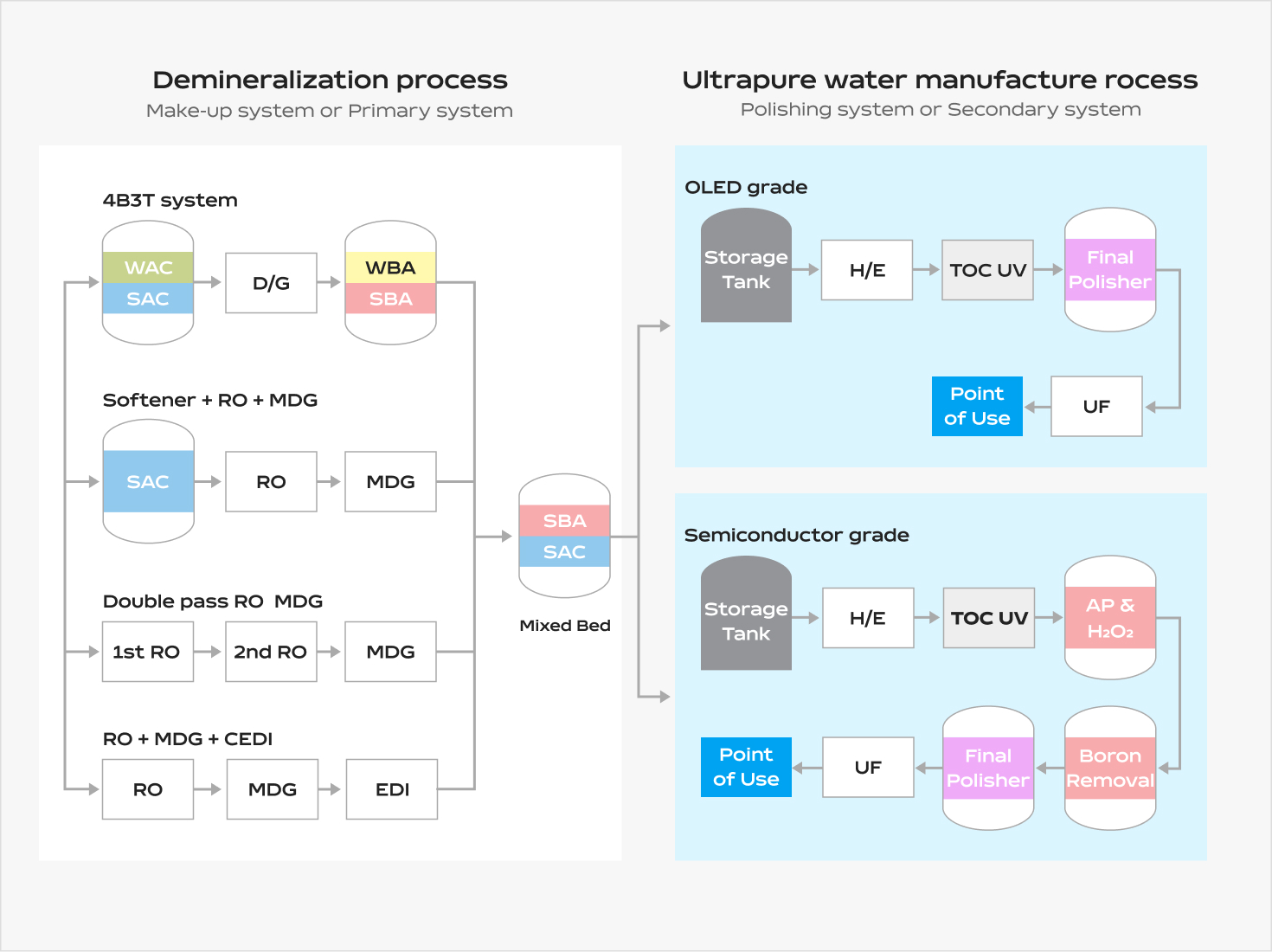
Ultrapure water production purifies raw water step by step into industrial water, pure water, and finally ultrapure water. The process consists of Pre-treatment → Make-up system → Polishing system.
-
Step 1 – Pre-treatment :
Raw water is taken in and passed through a multi-media filter (MMF) and an activated carbon filter to remove suspended solids (SS) and residual chlorine. -
Step 2 – Make-up system :
Dissolved ions, organic matter (TOC), bacteria, dissolved oxygen, and carbon dioxide are thoroughly removed. -
Step 3 – Polishing system :
The final step polishes out the remaining trace ions, particles, and organics. Depending on the required grade, it is divided into display (OLED) grade and semiconductor grade; the semiconductor grade adds H2O2 removal and boron removal processes.
Product
Selection Guide
| Product Name | Outlet condition | Features and Application |
|---|---|---|
| UPRM100U | Guarantee) Resistivity > 17.0㏁∙cm Actual) Resistivity > 18.0㏁∙cm |
General electronics Demineralization, Final polisher |
| UPRM200U | Resistivity > 18.1㏁∙cm(in 30 min) △TOC < 5 ppb (in 120min) |
Display Demineralization, Final polisher |
| UPRM300U | Resistivity > 18.2㏁∙cm(in 30 min) △TOC < 1 ppb (in 180min) |
Display, Semiconductor grade Final polisher |
| UPRM400U | Resistivity > 18.2㏁∙cm(in 30 min) △TOC < 1 ppb (in 180min) Metal impurity (ppm, as Dry Base) Na<1, Fe<1, Zn<0.5, Al<0.5 |
Semiconductor grade Final polisher |
| UPHR1 | Resistivity > 18.2㏁∙cm(in 24hr) △TOC < 1 ppb (in 24hr) |
Removal of organic contaminants in semiconductors |
| CLR-B3UP | Resistivity > 17.0㏁∙cm(in 48hr) △TOC < 5 ppb (in 48hr) |
Ultrapure Water boron removal |
Product
| Product Name | Product Category | Information | TDS |
|---|
Data Download

*Required fields
-
 Collected Information
Email, Name, Country, Company, Job title
Purpose of CollectionHomepage quality analysis and improvement, Service provision.
Retention and use period3 years after requesting data download.
※ The collected information will not be used for purposes other than the specified purpose. ※ Service can be used after agreeing to the terms and conditions. ※ This website uses cookie information for user convenience. View terms and conditions
-
Collected Information
Email, Name, Country, Company, Job title
Purpose of CollectionInformation and benefits related to products, webinars, exhibitions, etc.
Retention and use period3 years after requesting data download.
※ The collected email, name, country, company, job title, and area of interest are only used for sending marketing information in accordance with our privacy policy and will not be used for any other purpose. ※ Refusal to provide personal information and to receive emails may result in the inability to receive our services.


